

9 Things about Electrical Isolator
Views: 0 Author: Site Editor Publish Time: 2026-08-04 Origin: Site


Procuring electrical equipment carries high stakes for any industrial facility. Specifying the wrong Electrical Isolator creates severe compliance and safety liabilities. It goes far beyond simple operational downtime and equipment damage. Buyers often treat these critical devices as basic commodity switches during the decision stage. They routinely ignore crucial environmental factors, safety standards, and load-handling variables. Such oversights put maintenance personnel at extreme physical risk. A poorly selected switch can easily lead to catastrophic arc flashes or unexpected system failures. This guide introduces nine non-negotiable factors you must evaluate before finalizing a vendor or specification. Plant managers, electrical engineers, and procurement teams will learn how to secure the right components safely. You will discover exactly how to align your specific facility needs against rigorous industrial safety benchmarks.
Key Takeaways
Electrical isolators are strictly off-load devices; specifying them for fault-clearing is a critical safety hazard.
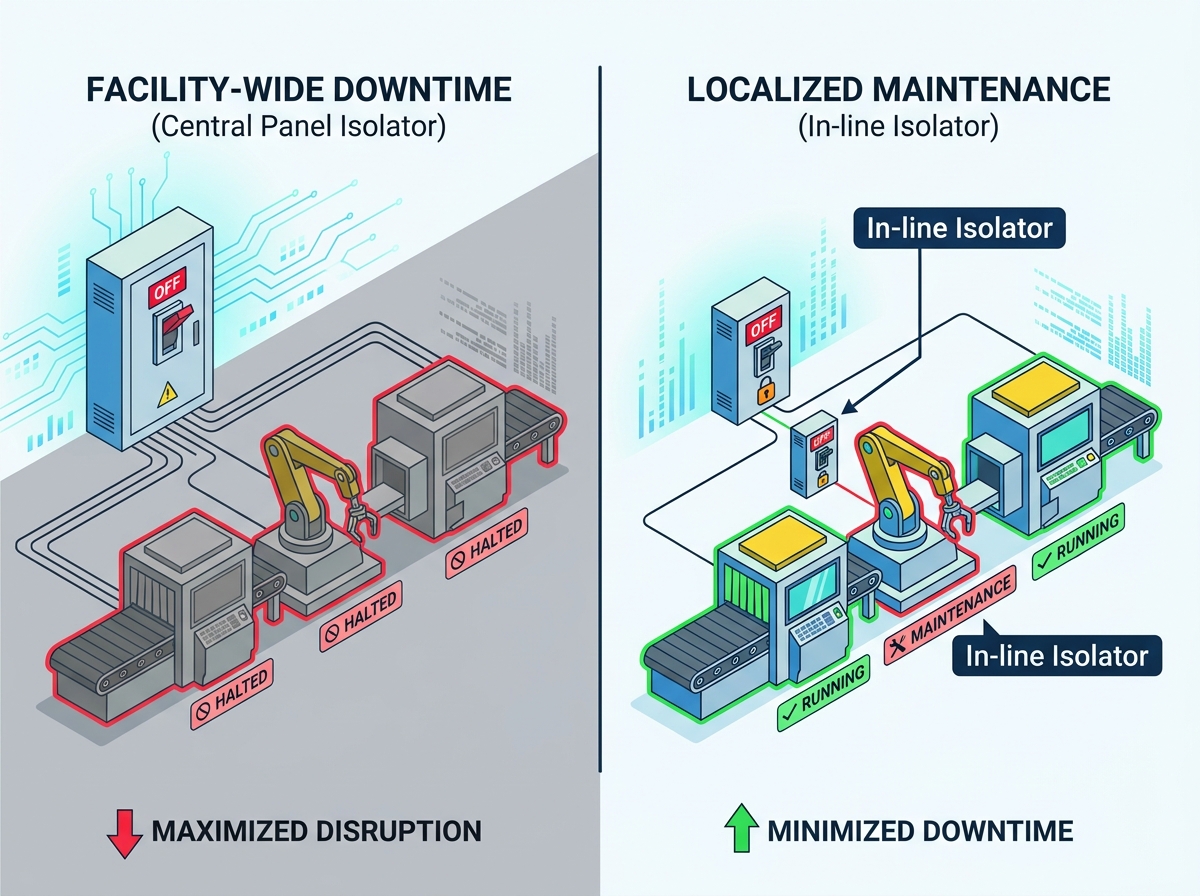
Integrating an in-line isolator localized to specific machinery prevents facility-wide downtime during routine maintenance.
Selection must align with site-specific OSHA LOTO (Lockout/Tagout) and IEC compliance standards.
Core Functionality and Problem Framing
Item 1: They Are Strictly "No-Load" Devices
Many procurement teams fundamentally misunderstand isolation devices. You must understand a crucial business and safety reality. These units only disconnect a circuit after a breaker stops the current. They cannot interrupt active electrical flow safely. When they open an active circuit, massive arc flashes occur. This destroys equipment and endangers human lives. Watch out for technicians trying to use them as emergency stops.
You face immense risk when evaluating isolation switches using circuit breaker criteria. Breakers protect machines from overcurrents and short circuits. Isolation devices exist purely for human safety. They provide a visible break in the circuit. Technicians rely on this physical gap before touching bare wires. Frame your successful procurement around protecting people first. Stop looking for fault-clearing capabilities in these components. You need absolute certainty a disconnected circuit remains dead.
Item 2: The Strategic Value of the In-line Isolator
Operational bottlenecks often plague large manufacturing floors. Implementing an In-line Isolator directly at the equipment level solves these issues quickly. Plant managers place these switches right next to specific machinery. A technician can then cut power to a single conveyor belt or motor. The rest of your production line keeps running completely undisturbed.
This approach delivers measurable business outcomes immediately. You avoid killing power to your entire facility during routine maintenance. Centralized panel disconnects force broad shutdowns. Localized disconnects keep other departments fully operational. This strategy directly saves thousands of dollars in downtime costs. It empowers your maintenance staff to work efficiently. They lock out one specific machine and finish their tasks faster. Your overall production metrics remain stable and predictable.
Technical Evaluation and Scalability Dimensions
Item 3: Pole Configurations Must Match Phase Realities
You must break down your selection logic based on phase requirements. Single-pole switches work best for simple residential or light commercial needs. They isolate one live wire effectively. Industrial systems operate differently. Three-phase systems demand three-pole or four-pole configurations. A three-pole switch disconnects all three live phases simultaneously. A four-pole version also disconnects the neutral line.
Applying the correct configuration ensures complete circuit de-energization. Here is a strict rule of thumb. Do not over-specify poles unless you have documented reasons. Neutral-line isolation might be required for specific generator setups. Future scalability plans might also justify extra poles. Otherwise, adding unnecessary poles increases physical bulk and wastes budget. Common mistake: Engineers sometimes install three-pole units on single-phase circuits simply because they have spare parts. This confuses future maintenance workers. They might assume three live lines exist. Stick strictly to what your current panel requires.
Item 4: Amperage and Voltage Ratings Demand Precision
Margin-of-error assumptions are dangerous in electrical design. You cannot rely on operational averages when selecting voltage ratings. The rating must withstand your system's maximum potential voltage. Spikes and surges happen frequently in industrial environments. An undersized unit will fail violently under stress.
Risk mitigation requires extreme precision during the specification stage. Under-specifying leads directly to arc flashes and catastrophic meltdowns. The physical contacts cannot contain the electrical pressure. Conversely, over-specifying aggressively inflates procurement budgets. You pay premium prices for capacity you never use. Review your single-line diagrams carefully. Identify the maximum continuous current. Select a rating closely matching this ceiling. Provide a sensible buffer, but avoid jumping three sizes up. Precision keeps your staff safe and your accountants happy.
Item 5: Environmental Placement Dictates Enclosure Selection
Your operational environment heavily influences enclosure selection. You must assess IP (Ingress Protection) and NEMA ratings carefully. Cleanrooms need smooth, easy-to-sanitize housings. Outdoor sub-stations demand waterproof and UV-resistant enclosures. Heavy dust manufacturing environments require completely sealed units. Particles entering a switch will ruin the internal contacts rapidly.
Financial planners must consider long-term lifecycle efficiency. Cheaper indoor-rated devices fail rapidly in harsh environments. Moisture corrodes metal terminals. Dust causes mechanical jamming. These failures completely negate your initial cost savings. Buying an expensive IP66 enclosure actually preserves your capital over ten years. We recommend standardizing environmental audits before purchase. Walk the plant floor. Note the temperature, humidity, and airborne debris levels. Match your enclosure ratings directly to these observations.
Security, Compliance, and Authoritative Standards
Item 6: LOTO (Lockout/Tagout) Compliance is Non-Negotiable
Regulatory bodies take human safety seriously. OSHA and international standards strictly enforce lock-out procedures. A technician must secure a circuit physically before touching it. Compliance protects your workers from accidental re-energization. It also shields your company from devastating legal liabilities and fines.
Your buying criteria must reflect these stringent safety rules. Only shortlist units featuring robust mechanical locking mechanisms. These locks must be tamper-proof and highly visible. Technicians use personal padlocks to secure the switch handle in the OFF position. Multi-lock hasps allow several workers to lock a single point. If a device cannot accommodate standard safety padlocks, reject it immediately. Safety protocols fail when equipment lacks proper physical safeguards. Prioritize robust, metal-reinforced lock holes over flimsy plastic tabs.
Item 7: The Necessity of Earth Switches
High-voltage applications introduce complex dangers. You cannot just break the circuit and walk away. Cables and transformers store residual capacitive loads. This leftover energy remains trapped even after the main power stops. High-voltage isolation units require integrated earth switches to handle this. The earth switch safely discharges this residual energy into the ground.
Standard industrial safety protocols explicitly define this requirement. Residual voltage remains a known, fatal risk during maintenance operations. Technicians have died touching isolated lines containing trapped capacitive charges. An integrated earth mechanism physically guarantees the line is dead. The blades connect the isolated circuit directly to the earth grid. You must demand this feature for medium and high-voltage substations. Never compromise on residual energy management.
Implementation Realities and Lifecycle Risks
Item 8: Mechanical Wear and Contact Resistance
Physical degradation remains unavoidable. Internal contacts endure friction during every single operational cycle. Copper blades scrape against receiving terminals. This friction gradually wears away the conductive plating. Bare metal oxidation follows quickly. Contact resistance spikes upward as surfaces become rough and pitted. Higher resistance generates dangerous heat under normal loads.
You need hard data to combat this degradation. Establish a strict evaluation metric for prospective vendors. Require them to provide data on mechanical endurance. Ask for specific contact material degradation reports. Good manufacturers test their units for thousands of cycles. They use advanced silver-plated contacts to minimize wear. Avoid brands refusing to share endurance testing data. Your maintenance teams need reliable components lasting decades, not months. Common mistakes include ignoring thermal imaging scans during annual checkups. These scans reveal hidden contact resistance long before mechanical failure occurs.
Item 9: Switchgear Integration and Retrofitting Constraints
Modernizing legacy electrical panels presents physical challenges. Older switchgear infrastructure rarely accommodates modern component footprints. Busbar alignments might not match new terminal positions. Space inside vintage cabinets is usually extremely tight. Forcing a large new switch into a cramped panel causes thermal issues. Wires bend at extreme angles, stressing the insulation.
Learn a valuable rollout lesson from experienced engineers. Always conduct a spatial and terminal-compatibility audit first. Do this before issuing any purchase order. Measure the available cabinet depth carefully. Check the incoming wire gauges against the new terminal blocks. Sometimes, you must buy specific retrofit kits. Other times, adapter plates solve mounting hole discrepancies. Proper spatial planning prevents costly delays during installation weekend. It ensures your newly purchased gear actually fits.
Shortlisting Logic and Next Steps
Selecting the ideal safety disconnect requires structured thinking. Buyers must aggregate multiple data points into a cohesive decision. The best approach involves building a formal procurement matrix. This tool helps you weigh different vendor offerings objectively. It removes guesswork and personal bias from the purchasing process.
Procurement Evaluation Matrix
Evaluation Criteria | Priority Focus | Key Question for Vendor |
|---|---|---|
Load Capacity | Maximum Continuous Amperage | Does this rating exceed our highest potential fault current? |
Environment | IP / NEMA Rating | Can this enclosure survive our plant's specific moisture and dust levels? |
LOTO Compliance | Lockout Padlock Compatibility | Does the handle accept standard multi-lock hasps safely? |
Form Factor | Spatial Dimensions | Will this unit fit into our existing legacy switchgear panels? |
Use this matrix to begin your vendor vetting process. Look closely for transparent testing documentation. IEC and UL certifications are mandatory proof of safety. Do not settle for internal company tests. Demand third-party laboratory verification. Furthermore, prioritize vendors offering accessible technical support. The lowest quote often lacks post-sale engineering help. You want a partner willing to assist during installation.
Three Next Steps for Your Team
Consult directly with an application engineer about your specific facility layout.
Request a detailed technical spec sheet for your intended enclosure models.
Review a localized product catalog to finalize your electrical system design.
Conclusion
An electrical isolator acts as a critical safety gateway. You must never treat it as a generic commodity component. The lives of your maintenance personnel depend on its flawless operation. Selecting the proper device requires deep attention to load limits. Environmental conditions and mechanical endurance also play massive roles.
We highlighted nine crucial factors throughout this guide. Aligning these factors with your operational realities ensures absolute safety compliance. You safeguard your personnel effectively against arc flashes and residual energy. Proper selection optimizes long-term facility uptime. Stop buying on price alone. Start procuring based on rigorous safety data and proven physical endurance. Make informed decisions today to protect your workforce tomorrow.
FAQ
Q: What is the functional difference between an electrical isolator and a circuit breaker?
A: A circuit breaker is an on-load device designed for protection. It automatically trips to interrupt fault currents and protect machinery. An isolation switch is an off-load device. It provides a visible, physical break in the circuit for human safety. You only operate it after the breaker stops the current.
Q: When should I specify an in-line isolator over a central panel isolator?
A: Specify a localized switch when you need to maintain single machines independently. Central panels require shutting down entire floor sections. Localized switches isolate just one motor or conveyor. This prevents facility-wide production halts and saves immense downtime costs.
Q: Do electrical isolators require regular maintenance?
A: Yes, they require consistent visual inspections. Maintenance teams should check internal contacts for physical wear and oxidation. Mechanical lock mechanisms need regular testing to ensure LOTO compliance. You must also verify enclosure seals remain watertight to prevent internal corrosion.
Q: How do I verify the right IP rating for my facility's isolator?
A: Indoor environments typically require IP40 to IP54 ratings for basic dust protection. Outdoor setups or heavy washdown manufacturing zones need IP65 or IP66 enclosures. These higher ratings block high-pressure water jets and completely seal out airborne particulates.


