

The Difference between A Diplexer And A Power Combiner
Views: 0 Author: Site Editor Publish Time: 2025-10-10 Origin: Site


A diplexer splits signals into different frequency bands. A power combiner joins signals to make more power or bandwidth. Both tools help you control RF signals. If you know this difference, you can choose better and stop interference.
The worldwide RF diplexer market was USD 6.33 billion in 2024.
Key Takeaways
A diplexer separates signals by their frequency. This lets many signals use one cable. The signals do not mix or cause problems.
A power combiner puts signals from different places together. It makes one output with more power. It does not split signals by frequency.
Use a diplexer when you need to handle signals in telecom or broadcasting. Use a power combiner when you need more power in your system.
Diplexer Basics
Definition
A diplexer is a passive device. It uses frequency-domain multiplexing. There are two ports called L and H. These ports connect to a third port called S. The signals on L and H use different frequency bands. This means the signals do not mix. Both signals can be on port S at the same time. They do not interfere with each other.
You use a diplexer to handle signals with different frequencies. It lets you send or get more than one signal using one cable or antenna. A diplexer is not like a power combiner. It keeps signals apart by their frequency. This stops them from mixing or causing trouble.
How It Works
A diplexer uses filters to split or join signals. Here is how it works in RF systems:
A diplexer splits signals by their frequency bands. This lets them use the same cable without causing problems.
It uses filters like low-pass and high-pass filters. These filters help control different frequency ranges.
For example, in a GSM transceiver, the diplexer splits uplink and downlink signals. These signals use different frequency bands.
A diplexer does more than just split signals. It also keeps each signal safe from interference. This makes it helpful in radio, TV, and wireless systems.
When picking a diplexer, check these values. Lower insertion loss means less signal gets lost. Higher isolation means better separation of frequency bands.
Power Combiner Basics
Definition
A power combiner is a device that joins radio frequency signals. You use it in places like broadcasting and aerospace. It takes signals from different sources, like antennas, and makes one output. The output has the total power from all sources. You do not need to split up the frequencies. The power combiner just adds power together.
How It Works
You connect several RF signals to the input ports. Inside, the device has resistors, inductors, and capacitors. These parts help match the phases of the signals. When the phases match, the output power goes up. If the signals have different frequencies, some energy is lost. This loss is small. Most power combiners can handle high power levels. The rating depends on the wires and the core size. Always check the power rating before you use it. If the signals match in phase, you get more output power. If they do not match, you lose about 3 dB for each signal.
Here is a simple table to help you:
Feature | What It Means |
|---|---|
Power Rating | Maximum input power |
Efficiency | How much power goes to the output |
Frequency Selectivity | Not selective; combines all signals |
A power combiner does not sort signals by frequency. You use it when you want to add power, not split signals.
Main Differences
Function
It is important to know how each device works with signals. A diplexer splits or joins signals by their frequency bands. This lets you send two signals through one cable. The signals do not mix together. Diplexers are used when you want to keep signals apart but use the same cable.
A power combiner does something else. It puts signals from different places into one output. The main job is to add the power from each signal. You do not need to care about the frequency of each signal. The power combiner just puts all the energy into one line.
Here is a table to help you see how they work:
Device | Functionality | Key Features |
|---|---|---|
Diplexer | Combines two signals from different cables onto one cable | Can shift frequencies; may be passive (just combines) or active (adds power) |
Power Combiner | Mixes different input signals with different frequencies into one output | No frequency translation; simply combines signals without alteration |
Tip: Use a diplexer if you want to keep signals apart by frequency. Use a power combiner if you want to add power from many sources.
Frequency Selectivity
Frequency selectivity means picking certain frequencies and ignoring others. A diplexer uses this to split or join signals from two frequency bands. This helps you use your bandwidth better. You can send or get two signals at once with no interference.
A power combiner does not have frequency selectivity. It just adds all the signals together, no matter their frequency. You cannot use it to keep signals apart. You use a power combiner when you only care about total power.
Applications
Diplexers and power combiners are used in many RF systems. But they do different jobs.
Common uses for diplexers:
Telecommunications: Combine or split transmit and receive signals in mobile systems.
Broadcasting: Split TV and radio signals into different frequency bands.
Satellite Communication: Send signals between a satellite dish and a modem.
Radar Systems: Split transmit and receive signals in radar antennas.
Power combiners are used in:
RF power amplifiers, where you join signals from many amplifiers.
Antenna arrays, where you combine signals from many antennas.
Test setups, where you add signals for measurement.
Design
Diplexers and power combiners are also different in how they are made and used. A diplexer uses filters, like low-pass and high-pass filters, to split signals by frequency. This design lets you work with certain frequency bands. For example, some diplexers work in bands like 1870.625–1879.375 MHz or 1950.625–1959.375 MHz. You can see how diplexers cover different frequency bands in this chart:
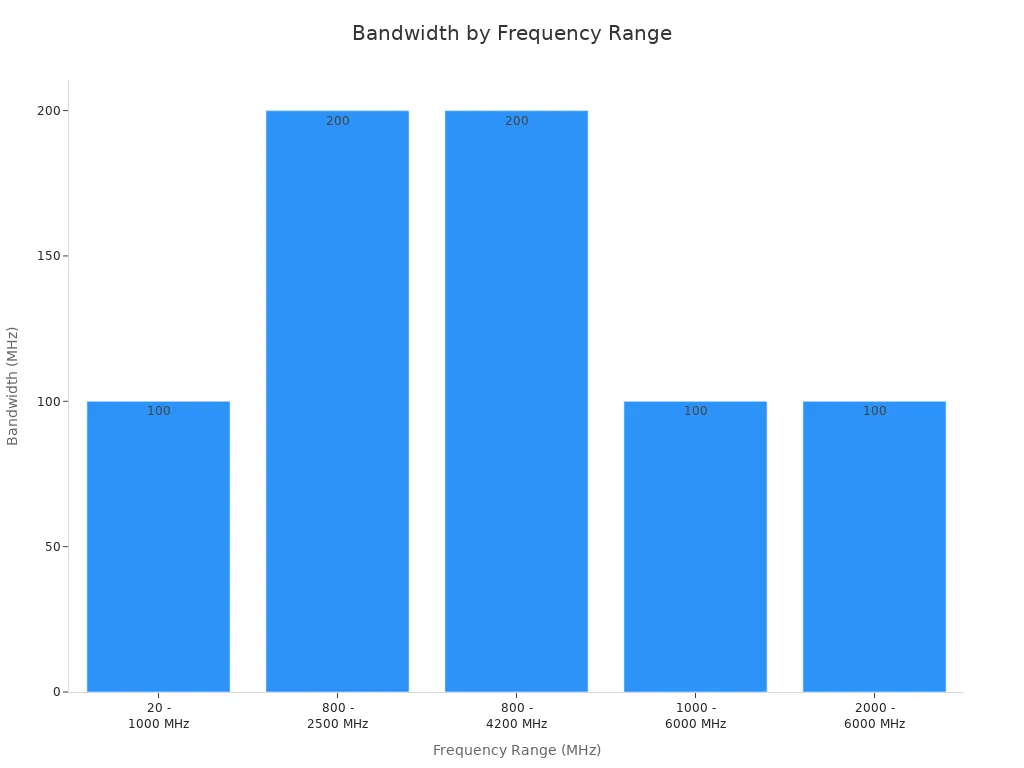
A power combiner has a simpler design. It uses resistors, inductors, or transformers to add signals together. You do not need filters because you are not splitting frequencies. Power combiners can work with wide frequency ranges, like 20–1000 MHz or 800–4200 MHz. They are made to handle high power.
When you pick between a diplexer and a power combiner, think about what you need. If you want to keep signals apart and manage frequencies, use a diplexer. If you want to add power from many places, use a power combiner.
Choosing the Right Device
Practical Tips
First, think about what your system needs. If you want to send two signals on one cable, use a diplexer. This device keeps the signals apart by their frequency. It helps stop interference between them. For example, in homes or apartments, a diplexer lets you use one cable for both internet and satellite TV. This saves space and keeps signals clear.
If you need to add power from many sources, use a power combiner. This device is good for joining signals from several antennas or amplifiers. Always check the power rating before you connect your devices. Companies like kernstech have both types of devices. You can pick the one that fits your project.
New technology makes choosing easier. Cavity diplexers now give high isolation for aerospace. Microstrip diplexers are small and fit well in cars and electronics. They are also affordable. Waveguide diplexers work in military and telecom jobs. For power combiners, new E-Plane designs can handle more power for radar systems.
Use Cases
Diplexers are used when you need to put different signals on one cable. In big buildings, a diplexer lets you use one wire for both TV and internet. This keeps signals strong and stops interference. In cars, microstrip diplexers help with GPS and radio signals.
A power combiner is helpful in labs or broadcast stations. You use it to join signals from many antennas or amplifiers. This setup gives you more total output power. In radar or solid-state systems, E-Plane combiners help you handle higher power.
Pick the device that fits your real needs. This makes sure your system works well and does its job.
You can look at this table to see the main differences:
Feature | Diplexers | Power Combiners |
|---|---|---|
Functionality | Combines signals by frequency bands | Combines signals without checking for interference |
Signal Handling | Shifts frequencies to avoid interference | Mixes signals directly |
Application | Used for different types of signals in one system | Used where signal combination is needed |
If you want to pick the right device, try these steps. First, think about what you need and what you want your system to do. Next, plan your system and choose the best technology for it. Then, build your circuit and test how it works. Last, check your results and make sure everything follows the rules.
Picking a diplexer or a power combiner helps your RF system work well. Companies like kernstech have both choices for your project.
FAQ
What is the main job of a diplexer?
A diplexer lets you send two signals through one cable. It keeps each signal in its own frequency band.
Can you use a power combiner for different frequencies?
You can combine signals with different frequencies. The power combiner does not separate them. It adds all the power together.
Where can you buy diplexers and power combiners?
You can find diplexers and power combiners at kernstech. The company offers products for many RF projects.


