

Why Use an Inline Isolation Tool?
Views: 0 Author: Site Editor Publish Time: 2026-08-10 Origin: Site


Pipeline maintenance carries extraordinarily high stakes for onshore and offshore operators. System modifications, valve replacements, and critical repairs often demand localized line shutdowns. However, draining an entire pipeline system remains commercially disastrous and environmentally reckless. Traditional intervention methods introduce their own severe complications. Techniques involving extensive welding, hot tapping, and mechanical line stopping trigger prolonged downtime. They compromise structural integrity and significantly inflate daily operational costs.
We need a modern, highly verifiable alternative to keep hydrocarbons flowing safely. Enter the Inline Isolation Tool. This non-invasive technology allows operators to achieve localized isolation precisely. Engineering and procurement teams increasingly prioritize this method over legacy line stopping. You avoid permanent pipeline modifications while securing verifiable safety barriers. In this guide, you will learn the core advantages, evaluation criteria, and crucial deployment strategies to optimize your next major intervention project.
Key Takeaways
Efficiency: Inline isolation eliminates multiple traditional maintenance steps (such as welding on bypass fittings), significantly reducing project timelines.
Pipeline Integrity: Reduces the need for permanent pipeline modifications (no hot tapping), preserving onshore and offshore pipeline integrity.
Safety & Compliance: Utilizes highly monitored, remotely operated Double Block and Bleed (DBB) mechanisms to meet strict ASME and industry safety standards.
Cost-Benefit: While upfront deployment requires precise engineering, the elimination of prolonged production shutdowns yields a superior ROI.
The Business Case: Traditional Line Stopping vs. Inline Isolation
Pipeline downtime costs operators millions in deferred production alone. Draining extensive pipeline networks causes huge logistical nightmares. Complex traditional line stops take weeks to execute properly. You lose critical revenue every single hour. The financial impact of halting throughput demands a faster, smarter intervention strategy. Financial teams evaluate these scenarios rigorously to minimize commercial exposure.
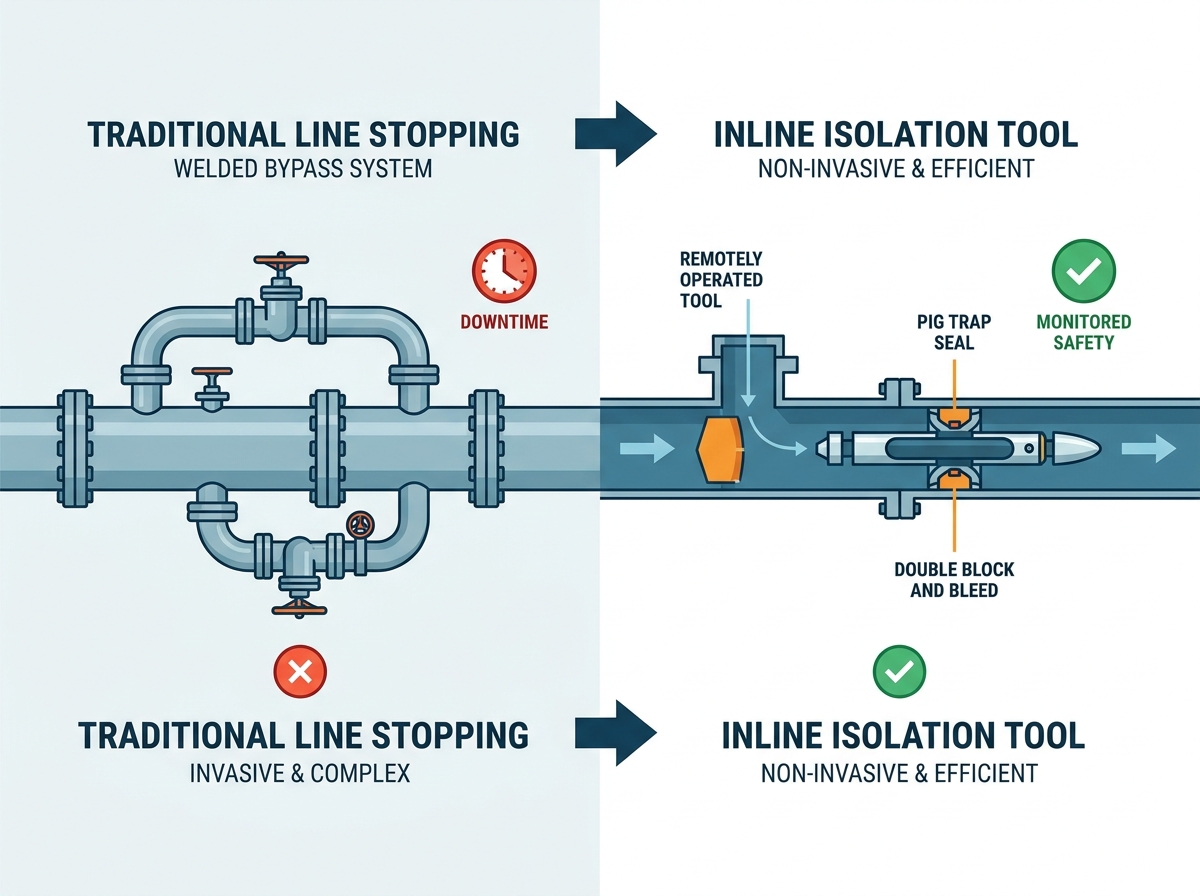
The mechanical realities differ wildly between these two methodologies. Line stopping requires physically cutting the pipeline walls. Operators must weld permanent heavy fittings onto live, pressurized lines. This invasive process demands massive exterior excavation work. Conversely, you deploy an Inline Isolation Tool through existing pig traps. The device travels internally directly to the target location. You eliminate external welding entirely. You avoid cutting the main pipe wall until the isolation is fully secured.
This non-invasive approach shrinks your environmental footprint drastically. Traditional external methods often release trapped hydrocarbons into the atmosphere. Heavy welding creates hazardous ignition risks near active facilities. Internal isolation keeps all hydrocarbons safely contained inside the pipe. It reduces the physical intervention site to almost zero footprint. Teams only need access to the existing pig trap and a clean remote monitoring station.
Intervention Methodology Comparison
Evaluation Metric | Traditional Line Stopping | Inline Isolation |
|---|---|---|
Invasiveness | High (Requires hot tapping and cutting) | Zero (Internally deployed) |
Environmental Footprint | Extensive (Heavy excavation required) | Minimal (Uses existing infrastructure) |
Structural Impact | Permanent welded fittings left behind | No permanent modifications made |
Deployment Speed | Slow (Requires extensive civil works) | Fast (Deploys via standard pigging) |
Core Advantages: Why Use an Inline Isolation Tool?
Uncompromised Pipeline Integrity
Every external weld introduces a potential metallurgical weakness. Hot tapping creates permanent stress concentration points along the infrastructure. These external modifications eventually become future leak paths. Avoiding permanent welded fittings preserves your physical asset base. You leave the original pipeline wall completely untouched.
This non-destructive strategy aligns perfectly alongside long-term integrity management programs. Both onshore and offshore operators benefit immensely from this preservation. Regulatory bodies favor maintenance techniques leaving no permanent artifacts. You extend the operational lifespan of the pipeline effortlessly. Engineers consider this a major victory for infrastructure reliability.
Operational Efficiency & Step Reduction
Redundant maintenance steps waste valuable project time. Traditional methods demand exhaustive preparation and lengthy recovery phases. An internal isolation strategy accelerates the entire project workflow. You bypass archaic preparation requirements completely.
Consider these eliminated operational phases:
Fully draining the targeted pipeline segment.
Purging remaining hydrocarbons from the larger surrounding network.
Welding heavy external bypass fittings onto the pipe.
Conducting extensive post-weld hydrotesting on new joints.
Bypassing these steps saves weeks of schedule time. You move straight to the required valve repair or pipe replacement. Project managers appreciate the simplified critical path. Your field crews encounter fewer logistical roadblocks during execution.
Verifiable Safety Metrics
Safety requires undeniable proof of a perfectly secure seal. This is where Double Block and Bleed (DBB) isolation standards excel. The tool deploys two independent primary seal modules. A dedicated bleed port sits directly between them. This central cavity creates the highly monitored annulus space.
Operators monitor this specific annulus pressure remotely. It provides real-time verification before any maintenance begins. If the primary seal experiences micro-leakage, the annulus pressure changes immediately. You know the exact status of your isolation barrier constantly. This undeniable proof allows personnel to safely cut the pipe downstream. They work confidently knowing the barrier remains completely intact.
Key Evaluation Dimensions: Selecting the Right Tool
Sealing Technology and Pressure Ratings
Not all sealing mechanisms perform equally under stress. You must evaluate the maximum operating pressure (MOP) rigorously. The tool must hold against specific pipeline backpressures safely. Pipeline medium dictates the optimal seal material selection. Gas, crude oil, and treated water behave very differently under high pressure.
You must understand material limits clearly.
Elastomeric seals: Handle standard pressures and benign liquids exceptionally well.
Non-elastomeric seals: Manage aggressive chemical environments and extreme pressures better.
Hybrid seals: Prevent explosive decompression in high-pressure gas applications.
Carefully match the seal composition to your specific pipeline medium. A mismatch causes premature seal degradation. It severely compromises the entire isolation operation.
Remotely Operated Capabilities
Tethered tools only work for very short distances. Complex routes demand completely remote operation capabilities. You need reliable through-wall communication protocols. Extremely low frequency (ELF) magnetic tracking provides this vital link reliably.
ELF signals penetrate heavy steel pipeline walls easily. Operators actuate, monitor, and unset the device entirely without physical tethers. This autonomy allows you to isolate segments miles away from the launch trap. Acoustic communication offers another viable alternative for specific offshore liquid lines. You must select the communication method fitting your exact environmental variables.
Independent Third-Party Validation
Never rely solely on aggressive vendor marketing promises. You must seek independent validation constantly. Look for strong, undeniable industry track records. Buyers should verify compliance against strict global engineering standards.
Look for ASME design code compliance documentation. Demand ISO certification for vendor manufacturing processes. Search for active listings in recognized platforms like the Technology Catalogue. Validated history proves the equipment works under real-world stresses. It reassures your internal safety committees before deployment begins.
Implementation Realities and Risk Mitigation
Pipeline "Piggability" and Pre-deployment Assessment
Inline isolation tools are not universally applicable everywhere. You must prepare the pipeline network thoroughly. Operators must conduct strict pre-deployment assessments. We advise an objective, highly critical review of your system architecture.
Verify pipeline internal bore variations carefully. Assess all structural bend radii strictly. Many rigid tools struggle traversing tight 1.5D bends. They navigate smoother 3D bends much easier. Unbarred tees pose significant navigational hazards. Internal pipeline coatings occasionally affect the tool's gripping traction.
Best Practice: Heavy wax or scale build-up prevents proper seal engagement. You must clean the pipeline extensively using progressive pigging runs before launching any isolation device.
Contingency and Recovery Planning
What happens if remote communication fails unexpectedly? You must establish foolproof fail-safe mechanisms immediately. No operator wants a stuck tool blocking daily production. Mechanical malfunctions demand comprehensive backup plans.
Standard recovery protocols guarantee safe equipment retrieval. Engineers design these advanced tools to unset under specific emergency conditions. Pressure equalization across the tool body forces the seals to retract. If electronic actuation fails completely, this mechanical override activates automatically. You regain product flow and easily retrieve the device backward. Always document these exact recovery procedures before launching the initial tool.
Shortlisting Providers and Procurement Next Steps
Vendor Track Record
Field experience matters far more than the base rental cost. You need vendors holding impeccable, incident-free deployment histories. Ask for detailed case studies involving your exact pipeline medium. Success in a 10-inch low-pressure water line means very little. Success in a 36-inch high-pressure gas line proves true capability.
Evaluate the vendor's specialized engineering pedigree. Do they understand complex metallurgical challenges? Can they calculate precise frictional resistance values? Demand absolute transparency regarding their past field failures. Honest vendors explain how they corrected previous operational mistakes.
Turnkey vs. Tool-Only Services
Decide your preferred procurement service model early. Do you just need raw hardware rentals? Or do you require complete, managed project execution? We strongly recommend turnkey services for complex, high-stakes interventions. Turnkey vendors provide full project engineering support.
They conduct detailed pigging feasibility studies internally. They deploy highly trained onsite technicians to manage actuation and monitoring. These experts handle the complex ELF communication arrays directly. Relying on specialized vendor personnel reduces your internal team's operational liability.
Actionable Next Step
Do not delay your upcoming project planning. Conduct a site-specific feasibility study immediately. Request a technical consultation from vetted, qualified vendors. Compare the total projected project timeline against traditional line stopping methods. Present this exact comparative data to your internal procurement stakeholders.
Conclusion
An Inline Isolation Tool represents a strategic upgrade for proactive pipeline operators. It protects long-term infrastructure integrity effectively. You completely eliminate hazardous hot tapping and external welding requirements. The technology ensures verifiable field safety through highly monitored DBB mechanisms. Operational continuity improves drastically by avoiding full system fluid draining.
To move forward securely, take these critical next steps:
Audit your upcoming intervention projects for basic internal piggability.
Contact specialized pipeline engineering teams for a detailed technical review.
Download comprehensive technical specification sheets from vetted equipment providers.
Compare your current downtime financial impacts against non-invasive isolation deployment timelines.
Embrace internal pipeline isolation to streamline your maintenance schedules safely. You will preserve your operational assets while maximizing overall daily throughput.
FAQ
Q: What is the difference between a tethered and a remotely operated inline isolation tool?
A: Tethered tools connect physically to the launch site via hydraulic or umbilical lines. You only use them for very short distances near the pig trap. Remotely operated tools use ELF magnetic or acoustic signals for through-wall communication. They operate autonomously over extremely long distances, navigating complex pigging routes effortlessly.
Q: Can an inline isolation tool be used in unpiggable pipelines?
A: Standard deployment requires existing pig traps and piggable pipeline geometry. However, you can utilize temporary external launchers if the intervention site allows. Tethered localized tools might offer workarounds for partially unpiggable sections, depending heavily on the exact location of your required maintenance.
Q: How does the tool prove the isolation is safe before we cut the pipe?
A: The tool utilizes the Double Block and Bleed (DBB) principle. It deploys two independent seals. Operators monitor the pressure in the annulus space situated between these two seals. A stable, zero-pressure reading in this space provides undeniable proof of zero leakage before personnel cut the downstream pipe.


